John Tchicai/Tony Marsh

LBO tour pictures
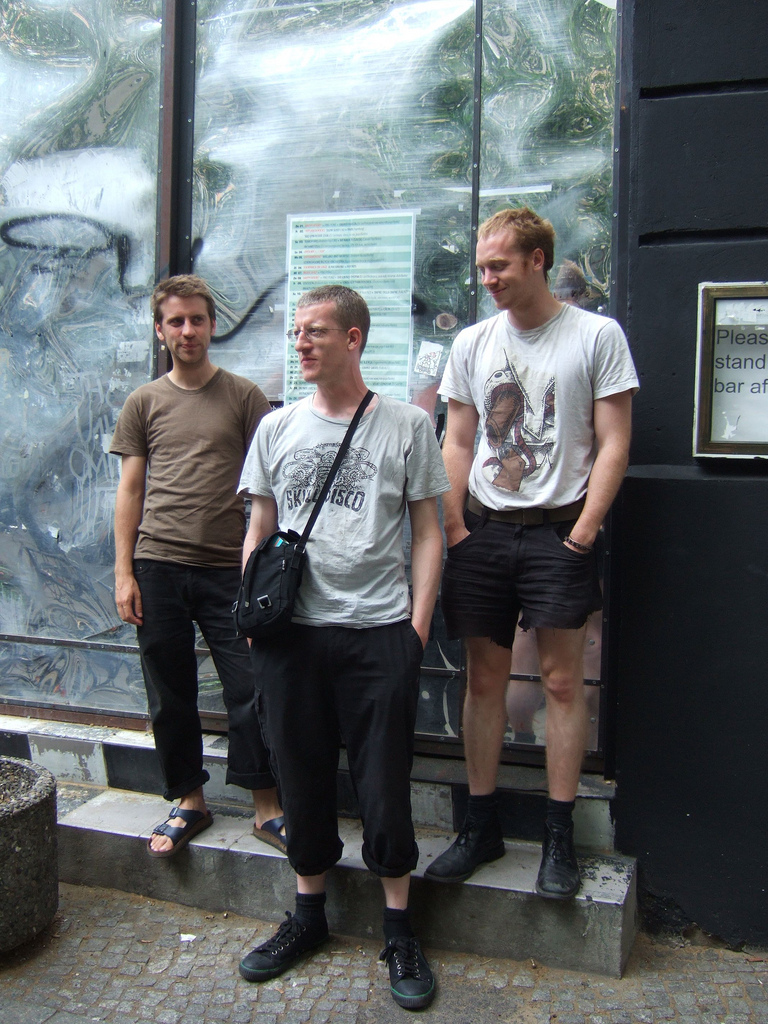
This is us outside the venue in Berlin. Had a great 2 weeks in UK, France, Germany, Switzerland, Austria and Holland in June. See many more moments of boy bandesque pain and beauty on Huws blogspot here. Hopefully there’ll be some audio and the infamous ‘tour diary’ appearing at some point.
Mumtaz Power Duo
Uploaded a couple of more improvisations from the newly named Mumtaz Power Duo. Im playing guitar and Nicolas Dobson is on percussion. All tracks recorded in The Milkroom at Hotspur Press.
music and Iran….
Really was quite flabbergasted today to read that music has been essentially made non-existant in Iran.
“Khamenei said: Although music is halal, promoting and teaching it is not compatible with the highest values of the sacred regime of the Islamic Republic.”
Terrifying that a state is prepared to go to such lengths to attempt to control a population, especially when Persian culture has such an amazingly rich musical history much of which has been intertwined with Islam throughout that history.
See tanbur player Ostad Elahi for one insight into how religious belief and incredible music are perfect partners. Hear his playing here.
Also check out setar player Saeed Hormozi below…
Henry Corbin is another interesting figure relating to Iran and religious/philosophical/musical traditions.
John Tchicai/Tony Marsh
putting on this gig with a few other folk later in the year, promises to be amazing!
Friday 1st October@ Carlton Club, Carlton Road (off Wood Road and Upper Chorlton Road) Whalley Range, M16 Manchester
John Tchicai
John Tchicai is a sax legend having played with some of the most innovative and respected musician in the field of free/jazz including John Coltrane, Don Cherry, Archie Shepp, Albert Ayler, Lee Konitz, and Cecil Taylor. He performed on Coltrane’s “Ascension” album and went on to cofound the New York Art Quartet. While in New York he also performed with John Lennon and Yoko Ono. Since the 60s he has continued to develop his work receiving grants from the Danish government. He currently lives in the US and France.
Tony Marsh
is a long time member of the London Improvising scene; a master drummer playing drum kit and percussion with technique, touch and a compositional sense that allows time and no-time to exist side by side. This year Tony has played with: Evan Parker; Peter Brotzman; John Butcher; Paul Dunmall; Elliot Sharp; The London Improvisers Orchestra and The People’s Band.
electric excitment
Started playing electric guitar again today during practice and actually found I was really enjoying pulling new sounds out of it!
There’s a recording of a few ideas here track is “sketch 28/7/10.
Live in Ramallah
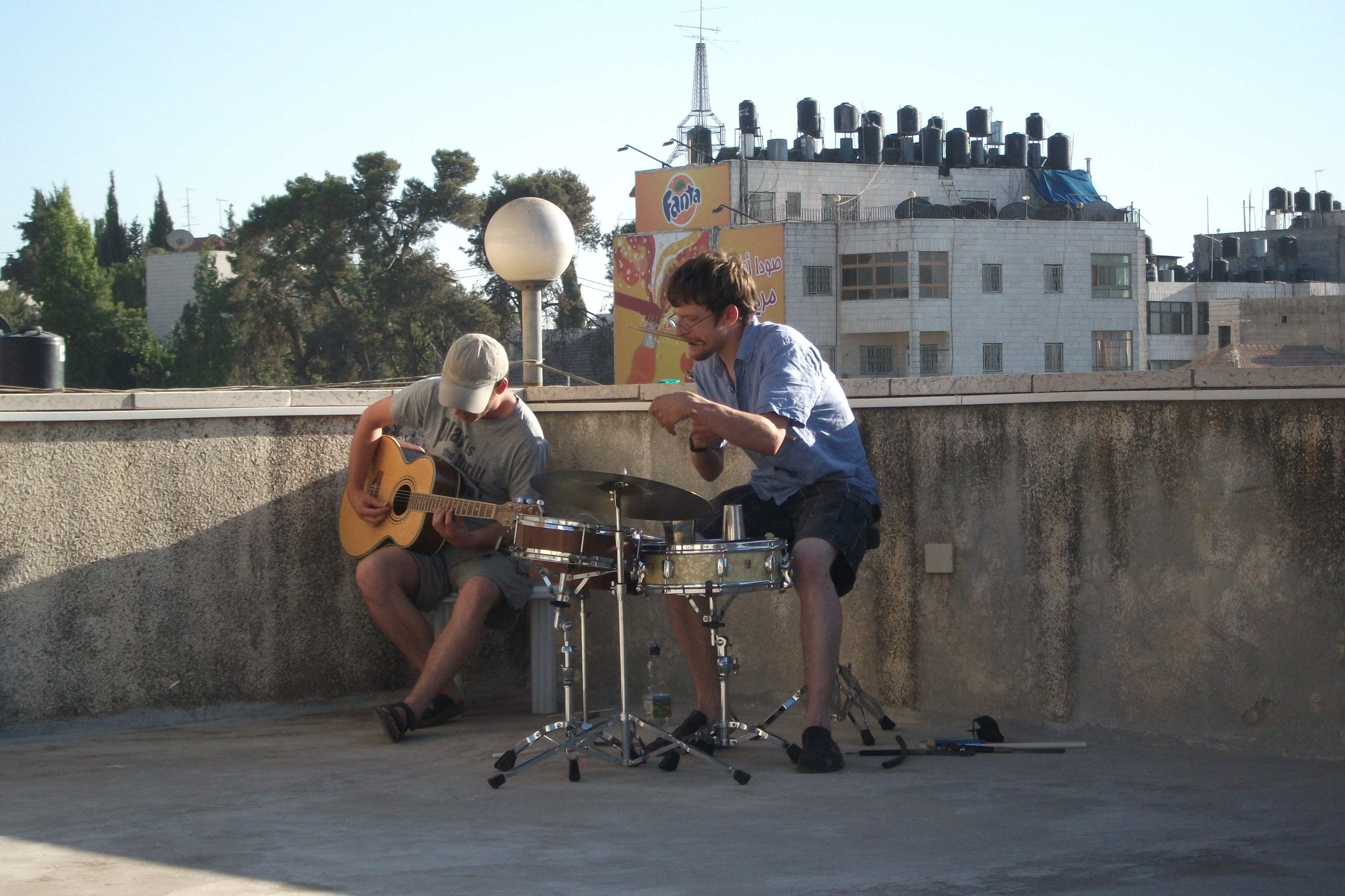
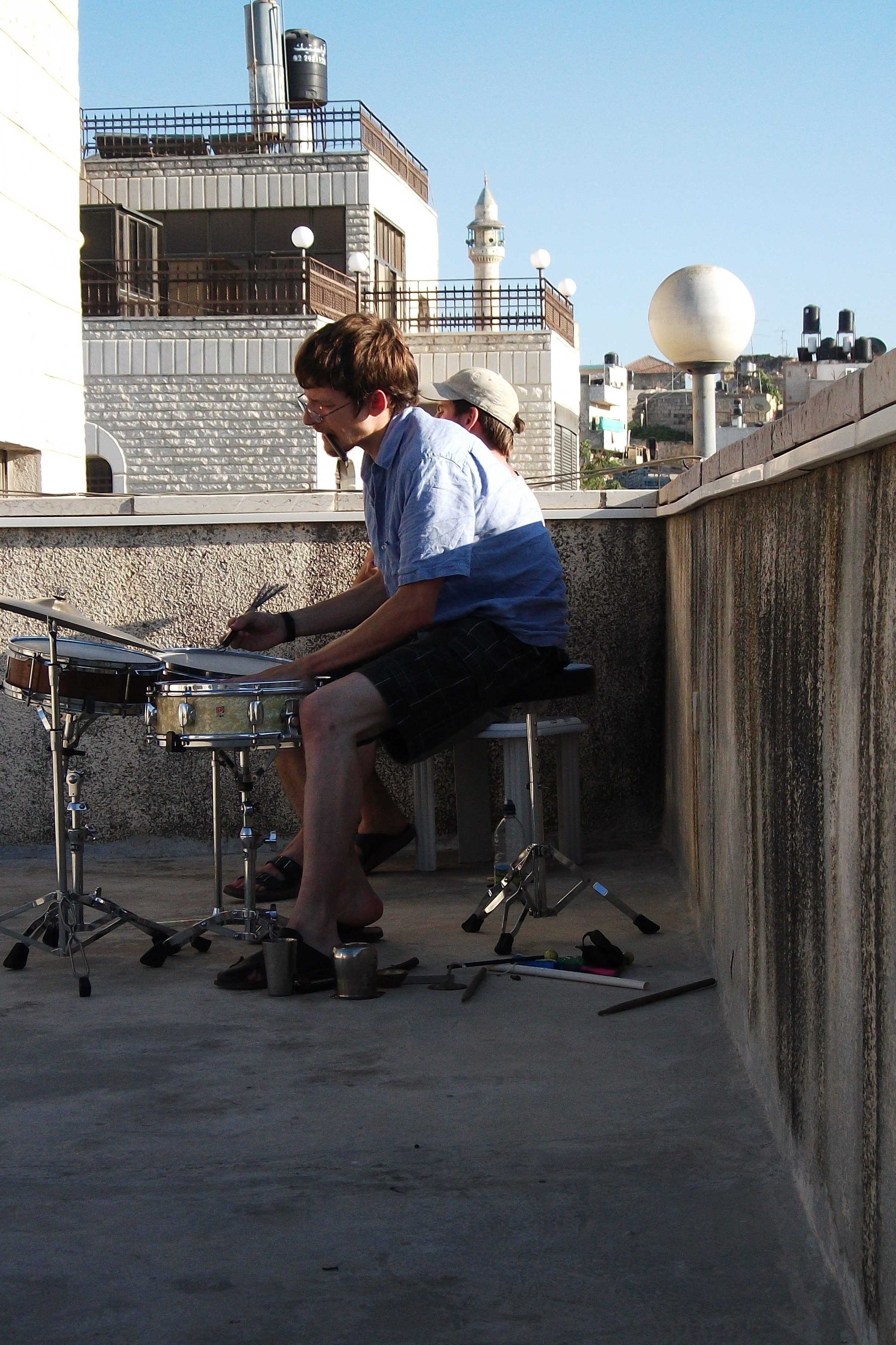
A few images from Ramallah of Nick and I at practice and then the gig itself on his rooftop. Gig itself was aided halfway through by the prayer call from a nearby mosque! Hopefully some duo records will surface on CDR later in the year.
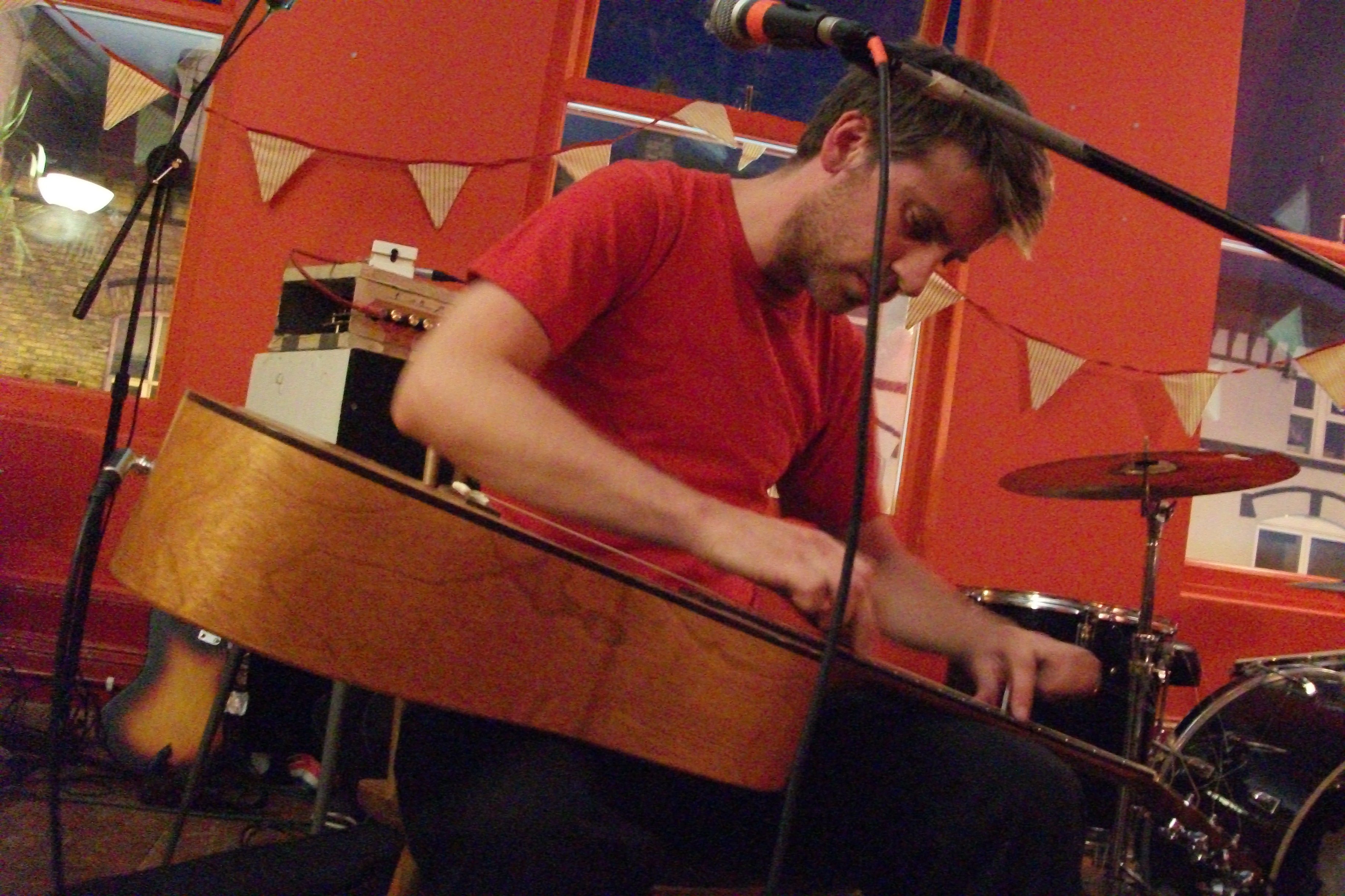
Below is a shot from solo gig at Fuel in Manchester last night. Note I’m using the giant guitar.
Nine Doors Review
Cool review here of LBO CD from the good folks at diskant
=====================================================
Levenshulme Bicycle Orchestra. Levenshulme Bicycle Orchestra. It’s so satisfying to say. It’s almost as satisfying to type out, time and again. Levenshulme Bicycle Orchestra. The best thing about the name is that it’s wholly accurate: Levenshulme Bicycle Orchestra are a troop of musicians based in a certain district of Manchester who come together to make music from all kinds of instruments, including bicycles. They’ve been a going concern for a few years now, but this is their debut release; a full-length CD album (or download if you’re so inclined) capturing nine of their collective improvisations for posterity and general confusion.
“Marlon. Marlon Brando are you the famous film star?”
And he says, “yes I’m afraid I am.”
“Why aren’t you happy with your existence?”
“Well that’s the question isn’t it?”
Confusion? Yes. It’s not like they don’t warn you: open up the beautifully packaged CD, pull out the bonkers fold-out poster and look on the back; you’re confronted with what reads like the ramblings of an insane man and a small disclaimer: “All lyrics improvised at time of recording and sung by Zeke S Clough”. Pity the fool that volunteered to transcribe them.
Zeke S. Clough (voice, synthesizer, percussion), perhaps better known for his insane artwork for Skull Disco that also adorns this release, is just one of the quartet of fearless improvisers that make up Levenshulme Bicycle Orchestra. Huw T. Wahl (bicycle percussion, clarinet, piano, voice), David M. (for Magnus) Birchall (bass, small instruments, percussion, voice) and Josh J. Kopecek (synthesizer, piano, flugelhorn) are the other constituent parts that make up this glorious whole.
So what is the sound of confusion? The album opens up with some typically deranged moans from Zeke, before some clattering of bicycle percussion, fizzing pedals and rhythmic random percussion. This builds up to a point of tension before Zeke begins his first sermon, quickly accompanied by bass thrums and other assorted layers before it all collapses into the next song. “Starved Dog” features a piano accompanying what sounds like someone playing a bass guitar with a slide, a kazoo and god knows what else. “Oily Film” features what sounds like the ghost of crazed organist playing the soundtrack toChopper Chicks in Zombietown, accompanied by creaks, groans and moans and the odd whoop here and there. “Whale in a Duckpond” almost sounds like an actual, recognisable song at various points, with some welcome musicality as David plays the bass like an upright and Zeke croons in his best Geno Washington impersonation. Then it all goes wrong; maggots start crawling over the windows and hell gradually breaks loose. “Marlon Brando”? Well, you know how that one goes. Everything starts falling apart by the time we reach “Primate Engineer” and Huw’s clarinet starts wailing over the top of abstract piano phrases, phased bass rumbles and some beatboxing. Eventually it all comes to a crashing, triumphant halt with final track “Nine Doors”, which runs a full 20 minutes and encapsulates virtually everything that precedes it, mutating from broken-down church organ jam to skeletal percussion workout to bizarre melody hopscotch, all held together by another bizarre, nonsensical story. A glorious hymn to the power of collective free improvisation, it’s probably the finest moment on this fantastically cock-eyed album.
“Nine Doors” is the sound of what happens when you lock four like-minded musical voyagers in a room for 2 days and distill their inevitable improvisations down to something that approaches the coherent “music” your lazy brain desires. Live, Levenshulme Bicycle Orchestra must sprawl all over the place as they take different paths towards collective enlightenment. On record, you’re served the mere highlights of their wanderings, jumbled-up and thrown together to create this mind-flaying assemblage of sounds, textures, noises, words and song. Running nicely over an hour, it might be too much to take in at one sitting, but keep listening and it’s the collective inspiration that frazzles your mind. Awesomely inspired and dazzlingly weird, simply nothing sounds like Levenshulme Bicycle Orchestra
Noise in Salford
Noise, Affect, Politics Conference
Call for Participation: “Bigger than Words, Wider than Pictures”:
Noise, Affect, Politics University of Salford and Islington Mill,
July 1-3 2010

Organising Committee: Dr Michael Goddard, Dr Benjamin Halligan and
 Professor David Sanjek

“If there are people that are dumb enough to use Metallica to
interrogate prisoners, you're forgetting about all the music
that's to the left of us. I can name 30 Norwegian death metal
bands that would make Metallica sound like Simon and Garfunkel.”
 – Lars Ulrich

“… this music can put a human being in a trance like state and
deprive it of the sneaking feeling of existing, ’cos music is
bigger than words and wider than pictures… if the stars had a
sound it would sound like this.” – Mogwai, “Yes! I Am a Long
Way from Home”

Noise Annoys. Is it not a banal fact of modern, urban existence
that one person’s preferred sonic environment is another’s
irritating, unwelcome noise – whether in the high-rise apartment,
 on public transport or the street, or almost anywhere else? The
contingent soundscape of jack-hammers and pneumatic drills, mobile
phone chatter, car sirens and alarms, sound leakage from nightclubs
 and bars and – moving into the suburbs – lawn-mowers and amateur
renovation projects, neighbouring kids and dogs, represents a
near-constant aural assault. As a pollutant, noise can legally
 attain noxious levels; it is both potentially biologically
harmful and psychologically detrimental.

But what exactly is noise and what conditions these relative
 thresholds in which sound crosses over into noise? Or are
these more organised and polite sonic phenomena merely varieties
of noise that have been tamed and civilised, and yet still contain
 kernels of the chaotic, anomalous disturbance of primordial noise?
 As a radical free agent, how is noise channelled, neutralised or
enhanced in emergent cityscapes? As a consumable, how is noise –
or lack of noise – commodified?

Such questions are particularly applicable to contemporary forms
of music which, based as they are on a variety of noise-making
technical machines, necessarily exist in the interface between
chaotic, unpredictable noise and the organised and blended sounds
 of music and speech. Does modern noise seek to lead us to new,
post-secular inscapes (as with psychedelia and shoegazer), or
defy the lulling noisescapes of processed background muzak with
punitive blasts of disorientating, disorderly noise? And why the
cult of noise – in term of both volume and dissonance – in which
low cultural practices (metal, moshing) meet those of the avant-garde (atonalism, transcendentalism)?

This conference seeks to address the contemporary phenomenon of noise
 in all its dimensions: cultural, political, territorial,
philosophical, physiological, subversive and military, and as
 anomalous to sound, speech, musicality and information. Possible
topics include but are not limited to:

Psychedelic and Neo-Psychedelic Musics
Punk and Post-Punk Musics
Experimental Musics from Avant-Classical to Digital Noise / Raw Data
Industrial Musics and Cultures
Krautrock and German Noise
Shoegazer, Nu-Gaze and Post-Rock
Noise as Cultural Anomaly
Noise, Chaos and Order
Noise and architectural planning
Noise and digital compression
Noise Scenes from No Wave to Japan-Noise Noise and electronic music pioneers (Delia Derbyshire, Varèse, Stockhausen)
Noise and Territory
Sonic Warfare
Noise and Urban Environments / “Noise pollution”
Noise and Subjectivation
Sonic Ecologies
“White Noise”
Noise and Political Subversion
Noise and hearing impairment / deafness
Psychic / silent noise
Noise and mixing, particularly in nightclub environments
Noise in Cinema, Video and Sound Art Noise,
Appropriation and Recombination
Noise and Affect

The conference will be organised by the Centre for Communication,
Cultural and Media Studies at the University of Salford in
cooperation with Islington Mill, Salford and will take place from
the 1-3rd of July and will include both an academic conference and
noise gigs featuring amongst other groups, The Telescopes and
Factory Star with other special guests tbc.

Confirmed keynote speakers include rock historian Cosey Fanni Tutti from Throbbing Gristle, Chris and Cosey and other projects, Clinton Heylin, author of From the Velvets to the Voidoids and numerous other works on (post)punk and popular music, Stephen Lawrie of The Telescopes, and Paul Hegarty, author of the recent Noise/Music.
 David Birchall